

Most clients want price certainty as early as possible. That is understandable. Budgets need to be set, approvals need to be secured, and decisions often need to be made before every detail has been resolved.
The problem is that early price certainty is often asked for before the scope is defined clearly enough to support it.
That does not just create the risk of cost increases later. It can also distort decisions much earlier than that. Where the scope is unclear, some contractors will include cautious allowances, provisional figures or broad assumptions to avoid over-promising. Others may take a lighter view, exclude quietly, or assume matters away in order to produce a more attractive number. On paper, one price can look too expensive and another can look competitive, even though neither is necessarily based on a properly aligned understanding of the project.
In those situations, the issue is not simply price. It is that the project team may be making decisions on figures that are not yet reliable or comparable.
The problem is usually not the whole scope. It is the undefined parts
Most refurbishment and fit-out projects do not begin with a blank sheet. There is usually already a broad intention. The client may know they want to combine two units, divide one space into several, improve a frontage, upgrade services, or reposition an existing asset. The difficulty usually sits in the areas that are not yet fully defined.
Those undefined areas matter because they affect how different people interpret the job.
One of the most important parts of early scope definition is understanding what is genuinely non-negotiable and what can move to suit budget.
Some items are fixed by necessity. They may be structural works required to create a viable layout, fire escape works needed for compliance, access requirements, landlord obligations, or brand and design elements that the client is not prepared to compromise on. If those are not clearly identified early, there is a real risk that they get treated as optional, softened in assumptions, or priced inconsistently.
Other elements may have more flexibility. Finishes, extent of replacement, phasing, specification level, and parts of the visual upgrade may all be open to discussion depending on cost pressure and priorities. If those flexible elements are treated as fixed, the scheme can look more expensive than it needs to. If they are treated as flexible when the client actually sees them as essential, the opposite problem arises.
That is why early scope clarity matters so much. It is not about trying to define every last detail too soon. It is about being clear on what must happen, what is desirable, and what can be adjusted without undermining the purpose of the project.
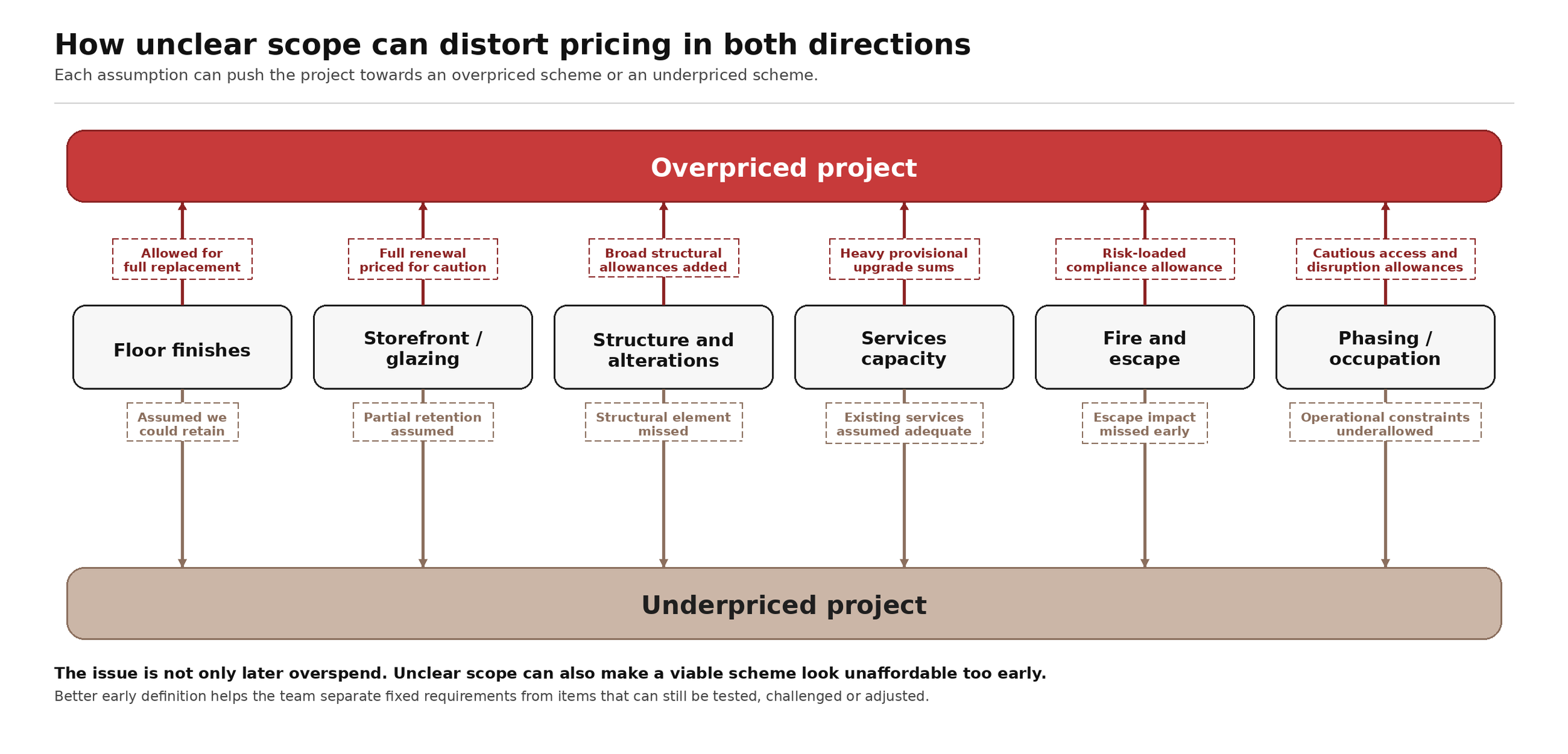
Poor scope can make viable schemes look unviable
There is a tendency to talk about unclear scope only in terms of cost overruns, but that is only half the story.
In practice, poor early definition can also make a scheme look less viable than it really is.
Where drawings are still developing, sketches need further detail, or building constraints are not yet understood, experienced contractors and quantity surveyors will often protect against the unknown. That can mean provisional sums, risk allowances, or pricing assumptions that are deliberately cautious. Sometimes that is absolutely the right thing to do. It is more honest than pretending certainty exists where it does not.
The difficulty is that those allowances can inflate the headline number to a point where a client, developer or investor starts to question whether the opportunity works at all. A project may appear too expensive on paper, not because it is genuinely unworkable, but because the scope has not yet been clarified well enough for sensible decisions to be made.
Equally, another tenderer may take a more optimistic position, either through experience, appetite for risk or a desire to look competitive. The result is that the project team ends up with prices that appear far apart, even though the underlying issue is not contractor efficiency but inconsistent interpretation of what is actually required.
That is where deals can fall away too early. A scheme gets judged on a number before the right conversation has even taken place.
“Poor early scope does not just create the risk of later cost increases. It can also make a viable opportunity look unaffordable before the right conversation has even taken place”
Non-negotiables need to be identified early
This is particularly important in refurbishment, adaptation and conversion work, where existing buildings bring constraints that new build teams do not always face in the same way.
If a project involves combining units, changing means of escape, adapting a frontage, working around an existing structure, or dealing with services that may or may not have adequate capacity, those issues need to be understood early. They may not all be fully designed yet, but they should be recognised as critical to the success of the scheme.
The same principle applies to more everyday scope decisions.
Floor finishes are a simple example. One contractor may assume existing finishes can be retained in part to protect budget. Another may allow for full replacement because they know retained finishes often create practical or visual problems later. If the client has not clearly stated which outcome matters, the project can quickly drift into false certainty. The price might look firm, but it is only firm against an assumption that may be wrong.
Storefront glazing is another example. A team trying to help a scheme work financially may assume parts of the frontage can remain. But if a new glazed frontage is non-negotiable for brand, visibility or planning reasons, then treating it as flexible distorts the whole exercise. The opposite can happen too, where teams load cost in for full replacement without testing whether a more targeted approach would still satisfy the brief.
These are not minor details. They are exactly the type of issues that determine whether a budget is realistic, whether a scheme still stacks up, and whether the eventual tender return is something the client can actually rely on.
Make it stand out
Early advice is about better decisions, not just pricing
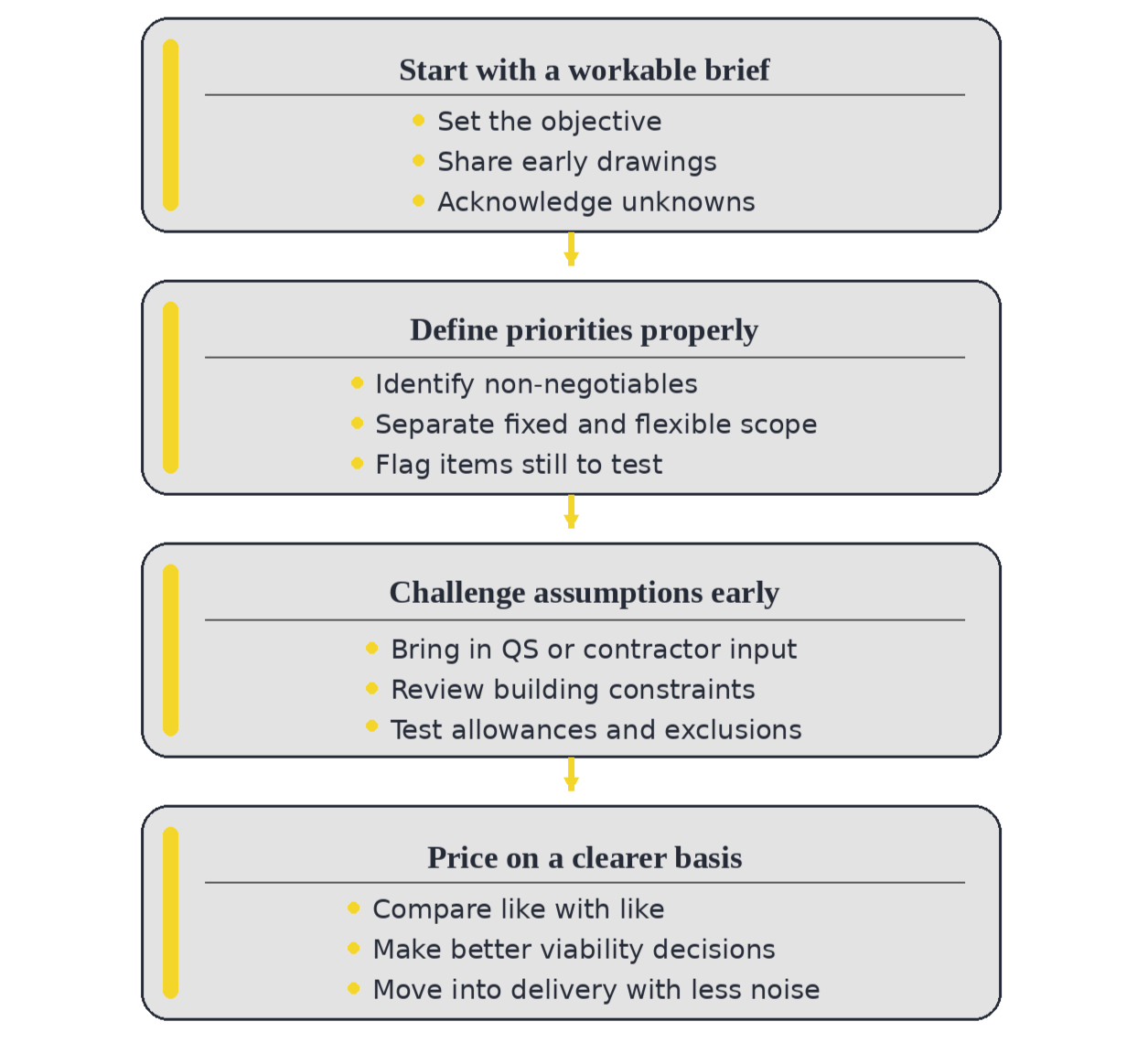
Bringing in an experienced contractor or quantity surveyor early is not simply about getting a faster price. Done properly, it is about testing the brief, identifying where assumptions are driving cost, and helping the client understand the likely impact of their priorities.
That might mean confirming which parts of the scope are genuinely fixed, which parts are open to challenge, and where alternative approaches could protect the scheme without undermining the outcome.
It might also mean highlighting where the building itself is likely to drive cost. In conversion or adaptation projects, for example, someone with relevant experience may identify likely pressure points around escape, fire strategy, structure, services or layout efficiency before a full package has been developed. That kind of input can stop a project being priced badly or dismissed for the wrong reasons.
Better early thinking leads to better outcomes
None of this means every project needs complete design certainty before pricing starts. That is unrealistic, especially in the early stages of refurbishment or conversion. It does mean, however, that early conversations need to be more disciplined.
Clients need to be clear on what is essential and what is adjustable. Project teams need to distinguish between hard requirements and areas where specification can move. Tenderers need enough information to explain where figures are firm, where they are provisional, and what assumptions sit behind them.
That is how price becomes useful.
Price certainty matters, but it is usually the result of better early thinking, not a substitute for it. Where scope is clearer, assumptions are open, and non-negotiables are properly identified, the team is in a much stronger position to judge viability, compare options and move forward with confidence.
And just as importantly, they are less likely to walk away from a good opportunity for the wrong reasons.
At Alessia Tudor, we value early conversations with clients, designers and the right quantity surveyors because better projects start with better definition. Where we are involved early enough to test scope, challenge assumptions and identify what really matters, the team is in a much stronger position to make sound commercial decisions. If you are at the stage of shaping a refurbishment, fit-out or conversion project, we are always happy to speak with project teams early and help make sure the right voices are in the room.